Garden Robin
Saturday, 17 October 2015
Garden Moths
Numbers of moths trapped over the last week or so have dropped due to cooler overnight temperatures. I am still getting several Large Yellow Underwings per night and the occasional Lesser.
I've had several Silver y's (Autographa gamma) in the trap recently.
These are immigrant moths from mainland Europe which often nectar on flowers during the day.
Silver y and Green-brindled Crescent (Allophyes oxyacanthae)
Green-brindled Crescent appears in two forms - I think this is one is f. capucina Mill which doesn't have the green scales. This form is only known in Great Britain and is more common in industrial areas such as the Midlands.
Setaceous Hebrew Character (Xestria c-nigrum)
Blair's Shoulder Knot or Stone Pinion (Lithopane leautieri)
First discovered on the Isle of Wight in 1951, the species has spread rapidly northwards and I've trapped quite a few individuals in recent weeks.
Angle Shades (Phlogophora meticulous) - has to be one of my favourite moths :)
I rarely trap Sallow species here (usually only one a year), Black Rustic should be appearing soon and I live in hope of trapping the holy grail moth Merveille du Jour. There is a grove of 15 plus Oak trees about 1/8th of a mile away so its possible!
Wednesday, 7 October 2015
Bog Garden and a few signs of Autumn
This summer it became very apparent how overgrown the bog garden next to the pond had become. Sadly, we had also lost some of our favourite plants, many of which were good for wildlife.
So B has decided to weed and clear the area, replanting the irises and a few other plants. He has also ordered some seeds to replace plants we had lost - Water Avens, Ragged Robin, Marsh Marigold and Lady's Smock. The seeds arrived this morning - beautifully presented and with little information sheets on the plants and how to sew/grow them.
Here is the cleared bog garden (looking horribly empty) although I notice brambles are still scrambling over the fence. I was a bit concerned at the time of year he has decided to tackle this job in case the area was used by hibernating animals/amphibians/insects. But there are plenty of other places for them round the garden.
This is a photo of the bog garden in 2013 before it got quite so overgrown. I tried to find a picture from this summer but I've hidden it away in a photographic file somewhere and can't find it.
Thanks for your helps and tips re: lack of flowers on nasturtiums. They are finally flowering. I have come to the conclusion that I probably planted them far too late in the year.
I've put a few rotting apples on sticks around the garden to try and attract butterflies. We had a Comma butterfly a few weeks ago when it was warmer which spent hours on the one apple.
Michaelmas Daisies (one of my favourites) are in flower now. We still have a few white flowered ones round the garden but sadly, all the deep pink ones, seem to have disappeared.
Autumn Leaves on the pond
It looks like a good year for pyracantha berries which will be attracting blackbirds and wood pigeons any day now.
Friday, 2 October 2015
Grey Wagtail
A record shot (through a rather dirty kitchen window!) of a Grey Wagtail seen on the garden lawn last Saturday.
We had a further visit a few days later from two individuals.
We do get visits from Grey Wagtails occasionally - usually at this time of the year.
Garden Moths
I put the trap out last night - the first time for a couple of weeks.
Results were disappointing - just 12 Large Yellow Underwings and 1 Light Brown Apple Moth. Min Temp was 5.5 degrees centigrade.
Have switched the trap on again tonight - and hoping for better results!!
Thursday, 10 September 2015
Painted Lady
Spotted the first garden Painted Lady (Vanessa cardui) of the year today
This brings the number of butterfly species seen in the garden this year to 14. I haven't seen Meadow Brown or Ringlet in the garden this year but Holly Blue and Gatekeeper have had an excellent year.
Monday, 7 September 2015
Moths, Butterflies, Spider and Flowers
I put out the moth trap last Friday and with a minimum overnight temperature of 4.9 degrees centigrade it wasn't surprising that there were very few moth species in the trap. Nothing seems to stop Large Yellow Underwing though as there were 21 individuals plus 4 Lesser Yellow Underwing, 6 worn Flounced Rustic and 1 Square-spot Rustic.
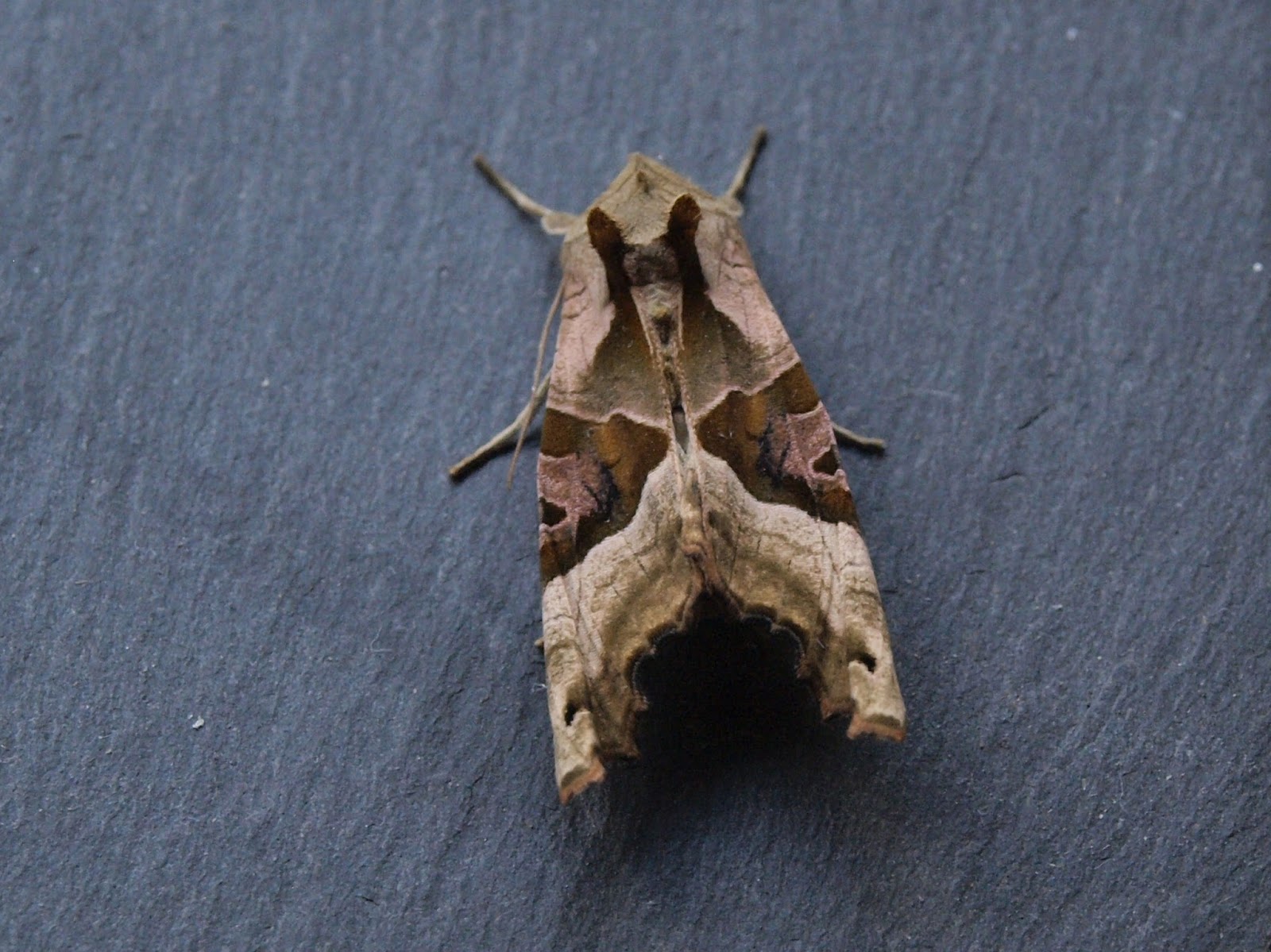
This beautiful Angle Shades (Phlogophora meticulosa) wasn't trapped but found on the landing the weekend before last. I should have taken a photo in a more natural environment as the wings resemble withered autumn leaves.
Echinops has produced more flowers than I expected this year following an attack of black fly!
Cosmos is flowering in nearly every border of the garden - a great flower for attracting insects especially bees.
We went out to our favourite blackberrying spot yesterday but only managed to gather enough to fill a small ice cream tub - most had already "gone over". In fact, when we got home we picked as many from the garden!
The wildflower area has been cut down - we left the seedheads lying round for a few days. As you may be able to see from the photo the dreaded Couch Grass is dominant. A huge packet of Yellow Rattle seeds has arrived in the post so, once the area is dug over, they'll be planted and it will be interesting to see the results!
Non-flowering Nasturtiums :(
Hanging baskets have done well this year although they are just starting to become "leggy". The colour combination is due to B collecting seeds from last year's plants and growing his own!
I've often bought pots of Chrysanthemums from Supermarkets in the past and they continue to do well if planted out in the garden.
Speckled Woods (Parage aegeria) in the garden
I saw my first Garden Small Tortoiseshell last week. Its been a poor year in the garden for this species, Comma's, Peacocks and Red Admirals although Holly Blues and Gatekeepers have done really well.
The flower and butterfly photos were taken with the Cannon Bridge Camera. It does have a tendency to over-expose flower photos when its sunny. I think Millymollymandy mentioned this? Will have to try lowering the ISO, and perhaps mess around with exposure compensation and possibly experiment with White Balance. White Balance is the one thing I tend to leave on Auto as changing it has often given some very peculiar results at least with the Olympus!
Finally, a couple of photos of a Garden Spider (Araneus diadematus) spotted in the front garden yesterday.
I know a couple of you were interested in the id of the "bottle-brush" plant. Just to let you know I've received an email suggesting an id - its Bridewort or Willowleaf Meadowsweet (Spiraea salicifolia). Many thanks to Tony.
Saturday, 29 August 2015
A few More Moths
A few photos of moths trapped on 17th and 21st August.
Square-spot Rustic (Xestia Xanthographa)
Yellow Shell (Camptogramma bilineata)
Flounced Rustic (Luperina testacea) Most of the moths trapped at the moment are either various species of Yellow Underwing, particularly Large, and Flounced Rustic!
Ringed China-mark (Parapoynx stratiota) A new species for the garden and thanks to those on Twitter who helped with id.
Copper Underwing Agg (Amphipyra pyramidea)
Orange Swift (Triodia sylvina) New for Year
Finally, an Antler Moth (Cerapteryx graminis) New for Year. I was really pleased to see this species (from memory I have only trapped one before)
Butterflies
Finally, Peacocks and Red Admirals have started to appear in the garden over the last couple of days. Holly Blues and Gatekeepers have been plentiful this August.
I found this insect on a Cosmos flower - I believe its a Shieldbug (Common Green?) nymph - probably Final Instar
Some of you may already have seen a photo of this book on my other blog but I really am very pleased with it although its more of a reference book than one to read from cover to cover!
Its been quite a few years since I stopped collecting stamps but I really couldn't resist ordering a Presentation Pack of Royal Mail's Bee Stamps.
The delightful stamp illustrations are by Richard Lewington and the text in the pack is written by bee expert Dave Goulson.
Labels:
bee stamps,
bees,
books,
garden butterflies,
garden insects,
garden moths,
garden shieldbugs
Sunday, 16 August 2015
Garden Moth Catch-up
A few photos of species trapped in the moth trap during August (all new for year).
The catches at the moment are dominated by various species of Yellow Underwing and now that Flounced Rustic has started to appear I suspect that they will be the second most common moth in the trap. August is exciting for me though as I keep an eye out for Hedge Rustic which is very very rare in Warwickshire and the County Recorder has been over the moon that I have trapped a couple in the last few years. So I will be scrutinising every single small brown noctuid very carefully indeed over the next four weeks! In fact, I thought I had trapped one last weekend but it managed to fly off whilst I was trying to pot it :(
Flounced Rustic (Luperina testacea) The larvae feed on the stems and roots of various grass species.
Willow Beauty (Peribatodes rhomboidaria) This species has appeared here very late this year. Larvae feed on Hawthorn, Plum, Privet, Birch, Ivy, Alder Buckthorn, Honeysuckle and Traveller's Joy.
Straw Underwing (Thalpohila matura). Larvae feed on various grass species. The underwing of this moth is very attractive being a creamy colour with a dark border.
Knot Grass (Acronicta rumicis) I find this moth difficult to distinguish from Poplar Grey so hopefully id is correct. Larvae feed on various herbaceous and woody plants e.g. Dock, Common Sorrel, Ribwort Plantain, Hawthorn and Bramble.
Bird-cherry Ermine (Yponomeura evonymella) Larvae feed on Bird Cherry - living together in silken webs and can sometimes cause much damage to the tree.
Common Rustic agg (Mesapamea secalis agg). Common Rustic is very similar to Lesser Common Rustic and Remm's Rustic - the 3 can only be reliably identified by dissection of genitalia! A route I will not be taking!
Copper Underwing Agg (Amphipyra pyramidea agg). Superficially Copper Underwing is very similar to Svennsons - somewhere hidden away in a storage box I do have a sheet which lists ways of telling the two species apart.
Bright-line Brown-eye (Lacanobia oleracea) Larvae feed on a wide range of herbaceous plants.
Single Dotted Wave (Idaea dimidiata) Larvae feed on Cow Parsley, Burnet Saxifrage and Hedge Bedstraw
The catches at the moment are dominated by various species of Yellow Underwing and now that Flounced Rustic has started to appear I suspect that they will be the second most common moth in the trap. August is exciting for me though as I keep an eye out for Hedge Rustic which is very very rare in Warwickshire and the County Recorder has been over the moon that I have trapped a couple in the last few years. So I will be scrutinising every single small brown noctuid very carefully indeed over the next four weeks! In fact, I thought I had trapped one last weekend but it managed to fly off whilst I was trying to pot it :(
Flounced Rustic (Luperina testacea) The larvae feed on the stems and roots of various grass species.
Willow Beauty (Peribatodes rhomboidaria) This species has appeared here very late this year. Larvae feed on Hawthorn, Plum, Privet, Birch, Ivy, Alder Buckthorn, Honeysuckle and Traveller's Joy.
Straw Underwing (Thalpohila matura). Larvae feed on various grass species. The underwing of this moth is very attractive being a creamy colour with a dark border.
Knot Grass (Acronicta rumicis) I find this moth difficult to distinguish from Poplar Grey so hopefully id is correct. Larvae feed on various herbaceous and woody plants e.g. Dock, Common Sorrel, Ribwort Plantain, Hawthorn and Bramble.
Bird-cherry Ermine (Yponomeura evonymella) Larvae feed on Bird Cherry - living together in silken webs and can sometimes cause much damage to the tree.
Common Rustic agg (Mesapamea secalis agg). Common Rustic is very similar to Lesser Common Rustic and Remm's Rustic - the 3 can only be reliably identified by dissection of genitalia! A route I will not be taking!
Copper Underwing Agg (Amphipyra pyramidea agg). Superficially Copper Underwing is very similar to Svennsons - somewhere hidden away in a storage box I do have a sheet which lists ways of telling the two species apart.
Bright-line Brown-eye (Lacanobia oleracea) Larvae feed on a wide range of herbaceous plants.
Single Dotted Wave (Idaea dimidiata) Larvae feed on Cow Parsley, Burnet Saxifrage and Hedge Bedstraw
Subscribe to:
Posts (Atom)